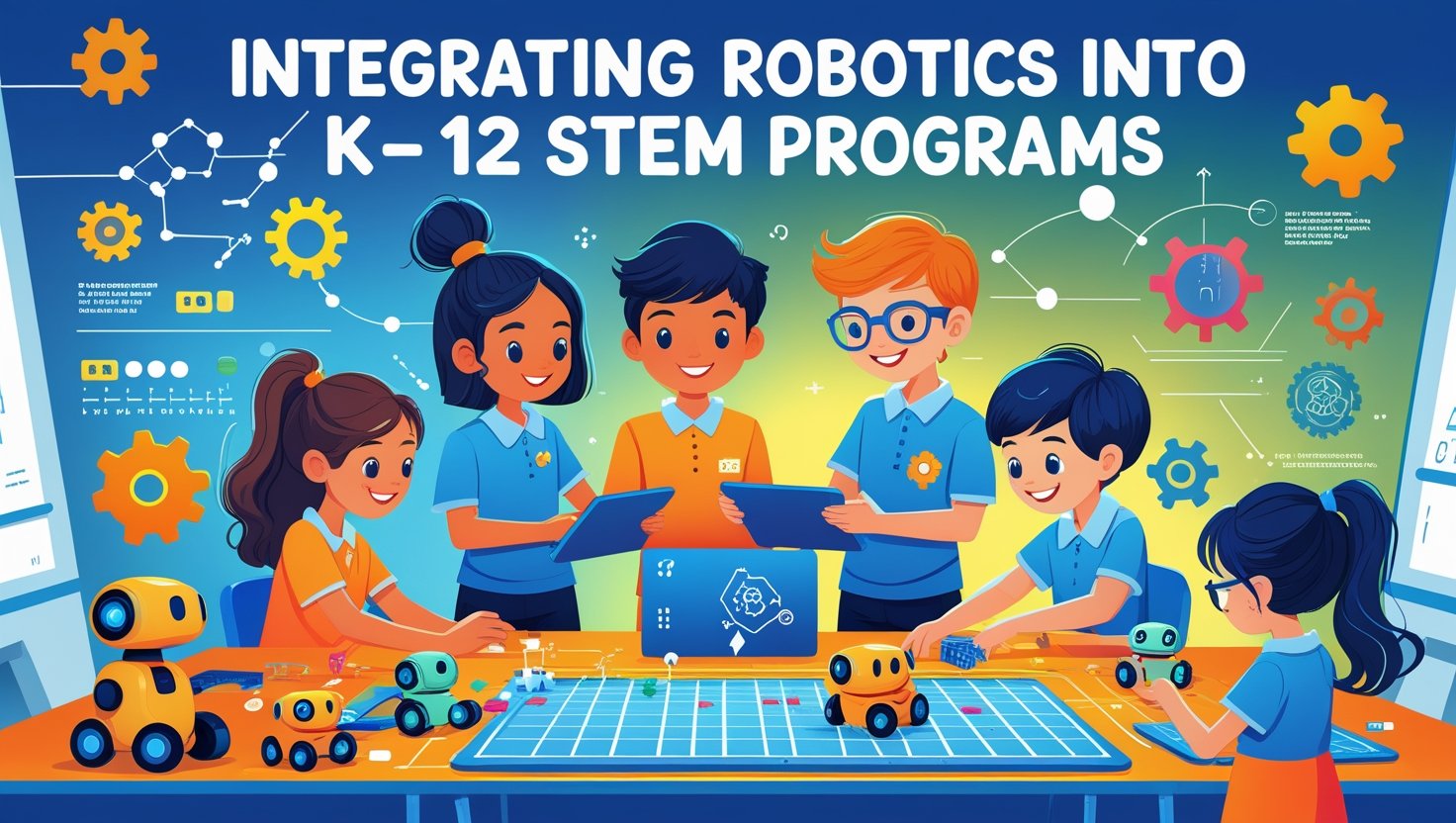
In today’s digital and tech-driven era, robotics is not just a subject of advanced science but has become an important part of modern education. Robotics means making intelligent machines that understand commands and perform actions. When robotics is integrated in STEM programs from K–12, i.e., from kindergarten to 12th grade, students get practical experience of technology, logic, and engineering from a young age. STEM means Science, Technology, Engineering, and Mathematics – and robotics is a combination of all these subjects. Because of this, robotics makes students’ learning engaging and interactive. If students are made to understand science and maths through robots from childhood, they learn the concepts better than boring theories. Robotics improves their thinking skills, teaches them teamwork and problem-solving, and promotes creativity in them.
Today’s generation, which has grown up with tablets and smartphones, finds traditional teaching methods boring, but robotics projects capture their interest. In this blog, we will explore how robotics works in K–12 education, what its benefits are for students, its link with the curriculum, and how educators can successfully implement it in schools. The integration of robotics can help today’s students become tomorrow’s innovators.
Benefits of Teaching Robotics in K–12 Classrooms:
When robotics is introduced into K–12 classrooms, it has an impact not only on students’ academic performance but also on their overall skills development. The first benefit is that robotics improves students’ logical thinking and problem-solving skills. When students design a robot or are given a command-based task, they have to think about how the robot will operate, what programming will be used, and how to fix an error if it occurs. This process enhances their analytical thinking. Another benefit is collaboration and teamwork. Robotics projects are often group activities where students have to work together. This develops communication skills and team spirit among them.
The third benefit is that robotics makes learning fun. When a student sees the program he has created come into action by a real robot, he gets satisfaction and motivation. Robotics also enhances creativity in children; they design robots with new ideas, think of new solutions, and bring their imagination into real form. Apart from this, robotics also engages students who normally feel bored in traditional lectures. In this way, robotics promotes inclusive education where every student can learn according to their own pace and interest.
Aligning Robotics with STEM Curriculum Goals:
When Robotics is aligned with STEM curriculum, students understand not just the theory but also its practical implementation. In Science, when students use sensors and circuits, they understand physics concepts such as force, energy, and motion practically. In Mathematics, when they calculate angles, distance, and timing, they learn through real-world examples. Engineering concepts such as design thinking, trial and error, and structural balance are understood by them when they make mistakes again and again and then improve them while building the robot. Technology is used at every step, from coding to automation.
The main goal of the STEM curriculum is to develop in students a spirit of logical thinking, real-world problem-solving, and innovation. Robotics gives practical shape to all these goals. When students make a robot to perform a task, they convert their subject knowledge into a functional product. This increases their interest, and they become self-motivated. Robotics also helps in interdisciplinary learning, meaning science, maths, and technology all come together in one project. Teachers can also make their lessons engaging by using robotics. In this way, robotics is not just an extracurricular activity but becomes an integral part of STEM education, which enhances the learning outcomes of students and prepares them for 21st-century skills.
Tools and Platforms for Introducing Robotics to Students:
Introducing robotics to students has become easier today than ever before, as there are many beginner-friendly tools and platforms available in the market. Kits have been designed for lower grades that children can use even without a programming background. Like LEGO Mindstorms, Bee-Bots, and Dash and Dot, these are colorful and interactive robots that teach children basic coding and movement concepts. Students in higher classes can program robots by learning coding using visual programming languages like Scratch and Blockly.
When students become a little advanced, they can work with Arduino, Raspberry Pi, and Micro: bit platforms, where they have to use real electronics and sensors. The biggest advantage of these tools is that they promote hands-on learning, where students see the theories in real form. Apart from this, many free and paid apps and software are also available where children can learn everything from drag-and-drop programming to full Python coding. Robotics kits also come with lesson plans, online tutorials, and teacher guides, which help educators understand which tool is best for students of all levels. These tools are not only affordable but also implementable for older schools. If the right tool is chosen, the integration of robotics can be easy and effective, making learning fun and powerful for students.
Challenges and Solutions in Implementing Robotics Programs:
When robotics programs are introduced in schools, some practical challenges also arise. The first challenge is funding. Purchasing robotics kits, laptops, and software licenses is not within the budget of every school, especially in schools in underfunded or remote areas. Another big issue is teacher training. Not every teacher has a background in robotics and programming, so teaching them and building their confidence becomes an important requirement. The third challenge is curriculum integration. Many schools consider robotics as an extracurricular activity and do not align it with core subjects. This prevents students from getting the full academic benefit of robotics. But solutions to these challenges are also possible. For funding, schools can seek help from local businesses, NGOs, and government STEM grants. Many organizations provide free or subsidized robotics kits to schools.
Online certification programs are available for teacher training, where educators can learn robotics and coding at a flexible time. For curriculum integration, educators should link robotics projects to their science and math topics, such as motion, measurement, angles, and logic gates. Online communities and YouTube tutorials are also helpful for both teachers and students. These challenges are not difficult if the planning and commitment are right. Schools should implement robotics as a future investment so that students can grow with 21st-century skills.
Conclusion:
Today’s students do not just need books but also need skills that will help them succeed in the future world. Integration of robotics into K–12 STEM education prepares students for a future where automation, AI, and intelligent systems are dominating. When a student learns to design, program, and solve problems of robots from a young age, he or she develops essential skills such as logical thinking, creativity, and adaptability. These are skills that are important in every career path, not just in engineering or technology fields. Robotics inspires students to be innovative, gives them the habit of finding practical solutions to real-life problems, and builds their confidence.
It shouldn’t just be a part of high-tech schools; every school, large or small, should include robotics in its curriculum. Today’s investments create tomorrow’s leaders. When schools take robotics education seriously, they empower a generation that emerges as creators, not just users. This blog highlights that robotics education is not just an option for the future; it’s an essential part of today. If we want to prepare our students for a tech-driven world, then we must make robotics an integral part of their education.
FAQs:
- Why should robotics be introduced in K–12 classrooms?
Robotics should be introduced in K–12 education because it makes STEM learning hands-on, engaging, and relevant to real-world problems. It helps students understand complex science, technology, engineering, and mathematics concepts practically. Robotics also builds essential life skills like critical thinking, collaboration, creativity, and problem-solving from an early age. - How does robotics align with STEM curriculum goals?
Robotics naturally blends science, technology, engineering, and math. For example, building a robot teaches physics concepts like motion and energy, while programming involves logic and math calculations. Engineering principles are learned through design and iteration. Robotics projects help students apply theoretical knowledge to solve real problems, which is the core goal of STEM education. - What tools and platforms are suitable for introducing robotics to students?
There are various tools tailored to different age groups and skill levels. For young learners, platforms like Bee-Bots, Dash and Dot, and LEGO Mindstorms offer visual, hands-on experiences. Older students can use platforms like Arduino, Raspberry Pi, or Micro:bit, along with coding languages like Scratch, Blockly, or even Python. Many kits come with tutorials and teacher guides to ease implementation. - What challenges do schools face in implementing robotics programs?
Schools often face budget constraints, lack of teacher training, and curriculum misalignment. Robotics kits and tech infrastructure can be costly, and not all teachers have the technical background to teach robotics. Moreover, some schools treat robotics as an extracurricular activity instead of integrating it into core learning. These issues can be addressed through grants, online teacher training, and curriculum mapping. - Is robotics education only for high-tech or private schools?
No, robotics education should be accessible to all schools, not just elite ones. Many affordable tools and open-source platforms make it possible for public and low-budget schools to integrate robotics. With proper planning, community support, and teacher training, robotics can be implemented in any school. It’s a vital step to ensure all students are prepared for a technology-driven future.